By Lovell T. Harmon, Sr. | Play Theory Project
Discovering Something New at the Gaming Table
One of the things I enjoy most about attending the Wednesday Night Board Game Meetup in Phoenixville is the chance to play games I might not otherwise have. Each gathering introduces different games, mechanics, and opportunities to engage with other adults who share an interest in tabletop gaming.
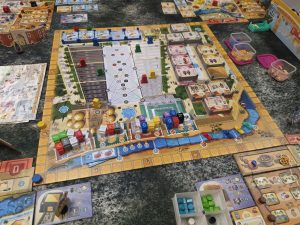
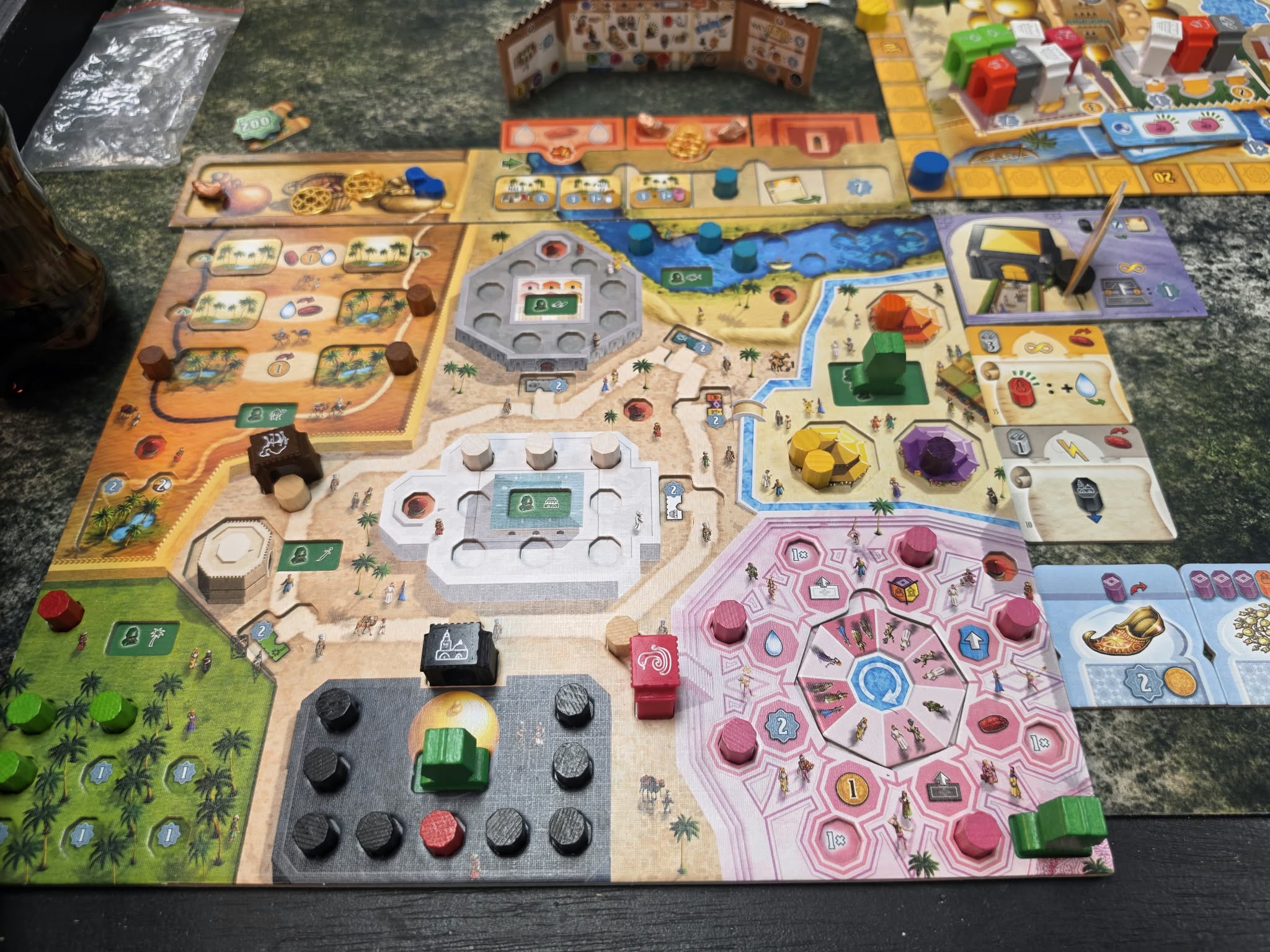
This week, I had my first opportunity to play Marrakesh, a strategy board game designed by Stefan Feld and published by Queen Games in 2022. I was fortunate to play the Deluxe Edition, which added considerably to the immersive experience. The upgraded components, colorful game board, and physical presentation made the game particularly enjoyable.
Set in the historic Moroccan city of Marrakesh, the game challenges players to become influential citizens by developing their standing in different areas of city life. Players can pursue opportunities involving trade, scholarship, religious institutions, agriculture, and commerce, while managing resources and building influence.
What immediately caught my attention was how the game incorporated Moroccan and Islamic cultural elements into its setting. References to mosques, scholars, markets, and caravans created an atmosphere that felt different from many strategy games I have played.
As someone familiar with Islamic traditions, I appreciated seeing aspects of that cultural heritage represented in a modern board game.
An Immersive Experience, Especially in the Deluxe Edition
One of the most enjoyable aspects of playing Marrakesh was the game’s physical presentation.
The Deluxe Edition includes upgraded components that make interacting with the game particularly satisfying. The colorful wooden pieces, known as keshis, represent the city’s different activity areas. Individual player boards, detailed artwork, and substantial components all contribute to the experience.
The game’s centerpiece is its cube tower, which adds an interesting element of uncertainty to the decision-making process.
Each round, players secretly select three colored keshis representing the areas where they intend to take actions. Players place these pieces into the tower, but not all of them necessarily emerge immediately. Some may remain inside and appear during a later round.
This creates an interesting challenge. You can plan your actions, but you can’t fully control which resources become available to strengthen them.
The Deluxe Edition made this process especially engaging. Handling the upgraded pieces, watching the keshis move through the tower, and placing them onto the player boards added a physical dimension to the strategy.
For me, this was a good example of how a game’s component design and quality can boost player engagement.
A Game That Rewards Long-Term Thinking
Marrakesh is played over three seasons, each consisting of four rounds, giving players twelve rounds to develop their strategies and build toward their final scores.
What makes the game especially interesting is the way its different systems reward long-term planning.
I would describe Marrakesh as having a strong engine-building element. As players acquire keshis and place them in different sectors of their player boards, they improve the effectiveness of future actions. A relatively modest action early in the game can create benefits that continue to grow over subsequent rounds.
That was one of the aspects I enjoyed most.
I found myself constantly considering whether to pursue an immediate benefit or invest in an area that might produce greater rewards later.
The game requires players to think several turns ahead. With only twelve rounds available, there is limited time to develop a strategy, and choices made during the opening season can significantly influence what becomes possible during the final season.
At the same time, the cube tower introduces enough uncertainty that players must remain flexible. You might have a clear plan for developing a particular area, but the availability of keshis can influence how quickly that plan develops.
This combination of planning and adaptation kept me engaged throughout the game.
I also appreciated that there were several possible approaches to success. Players could concentrate on different areas of city life, develop different combinations of actions, and pursue different scoring opportunities.
The challenge was determining which investments would provide the greatest value over the remaining rounds.
Cultural Representation and Curiosity
Another aspect of Marrakesh that stood out to me was its cultural setting.
The game draws upon the imagery and institutions of a historic North African city shaped by centuries of Islamic history and cultural exchange.
Players encounter references to mosques, scholars, marketplaces, caravans, and other activities associated with the city’s cultural and economic life.
I found these elements appealing, particularly because they reflected aspects of a cultural tradition with which I have a personal connection.
Of course, Marrakesh is a strategy game rather than a historical simulation. Its representation of Moroccan society is simplified, and playing the game does not necessarily provide a detailed understanding of Islamic history or culture.
However, it can encourage curiosity.
A player unfamiliar with Marrakesh might leave the table interested in learning more about the city’s history, architecture, or importance as a center of trade and scholarship.
For the Play Theory Project, that possibility is worth considering. Games can introduce unfamiliar subjects and encourage people to explore them further, even when formal education is not the primary purpose of the activity.
The Educational Value of Strategic Planning
At the Play Theory Project, we are particularly interested in how tabletop games can provide opportunities to practice social, emotional, and cognitive skills.
Marrakesh offers an interesting example because its mechanics require players to evaluate immediate opportunities while considering longer-term consequences.
Several skills stood out during my experience.
Long-term planning: Players must anticipate how decisions made early in the game will affect future opportunities. Developing an effective strategy requires looking beyond immediate rewards.
Decision-making: With multiple possible actions and limited rounds, players must evaluate alternatives and establish priorities.
Cognitive flexibility: The cube tower introduces uncertainty, requiring players to adjust their plans when resources become available in unexpected ways.
Strategic reasoning: Understanding how different sectors interact encourages players to recognize relationships between actions, resources, and scoring opportunities.
Patience and delayed gratification: Players frequently benefit from making investments that do not produce their greatest rewards until later in the game.
These skills have applications beyond gaming.
Consider the decisions involved in completing a long-term educational project, managing personal finances, or developing a professional career. Each requires the ability to establish priorities, anticipate consequences, and make choices that may not produce immediate results.
Marrakesh provides a recreational setting where players can practice similar forms of thinking.
That does not mean playing the game automatically improves these skills. However, it creates opportunities to exercise them, discuss decisions, and reflect on what worked and what did not.
For educators, that distinction is important. The learning potential of a game may become more meaningful when players have opportunities to reflect on their experiences and connect them to situations outside the game.
Learning Through the Experience
One of the things I have come to appreciate about modern board games is that the experience can be rewarding regardless of the final score.
Marrakesh kept me engaged because I was continually learning how its different systems worked together.
As the game progressed, I began to recognize opportunities that had not been obvious at the beginning. I also found myself reconsidering some of my earlier decisions as I developed a better understanding of how the game worked.
That process of discovery was part of the enjoyment.
There is something satisfying about making a decision early in a game and watching it produce benefits several rounds later. There is also value in recognizing when a strategy did not work as expected and considering what you might do differently the next time.
For adults, experiences like these can be particularly valuable.
We often associate structured learning with classrooms, training programs, or professional development activities. Yet a challenging board game can create opportunities to practice decision-making, evaluate outcomes, and learn from mistakes in a relaxed social environment.
And because the experience is enjoyable, participants may remain engaged with complex decisions longer than they would in a more traditional learning exercise.
Final Thoughts
My first experience with Marrakesh was a very positive one.
I enjoyed the cultural setting, the complexity of the decisions, and especially the engine-building mechanics that encouraged me to think several rounds ahead.
Having the opportunity to play the Deluxe Edition made the evening even more memorable. Its upgraded components and physical presentation contributed to the immersive experience and reinforced how much thoughtful game design can influence player engagement.
The game rewarded careful planning while requiring enough flexibility to respond to unexpected developments.
It also reminded me that tabletop gaming offers more than entertainment. Games can introduce unfamiliar cultural settings, encourage curiosity, and provide opportunities to practice skills that are useful in everyday life.
For the Play Theory Project, these are exactly the kinds of experiences we want to explore.
How can games help people develop stronger decision-making skills? How can they encourage patience and long-term thinking? And how might the experiences people have around a gaming table contribute to learning and personal development?
Marrakesh gave me another opportunity to consider those questions.
I look forward to playing it again, applying what I learned during my first experience, and seeing whether a different approach produces better results.
And I look forward to continuing to discover new games at the Wednesday Night Board Game Meetup in Phoenixville.
After all, part of the enjoyment of tabletop gaming is discovering how much there is still to learn.
About the Game
Marrakesh (2022)
- Designer: Stefan Feld
- Publisher: Queen Games
- Players: 2–4
- Playing time: Approximately 120 minutes
- Mechanics: Action selection, engine building, area development, cube tower
- Edition played: Deluxe Edition
BoardGameGeek: https://boardgamegeek.com/
The Play Theory Project explores how tabletop gaming can support learning, social-emotional development, and meaningful engagement among people of all ages. Through community gaming sessions, educational workshops, and shared experiences, we examine the value of play as a tool for personal growth and connection.